Highest recognition highlights Quantifind's AI-native approach to KYC, adverse media screening, and next-generation financial crime compliance
PALO ALTO, Calif., July 8, 2026 /PRNewswire/ -- Quantifind, the leader in AI-native Risk Intelligence for financial crime and national security, today announced it has been named a Luminary in Celent's Know Your Customer Systems: Adverse Media Screening Technology Capabilities Matrix and 2026 XCelent Awards.
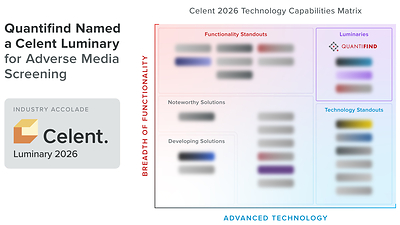
The Luminary designation is Celent's highest level of recognition within its Technology Capabilities Matrix and is awarded to solutions that demonstrate exceptional innovation, technology leadership, and product capabilities.
Recognized for AI-native Innovation
"Independent recognition from Celent reinforces what our customers experience every day," said Graham Bailey, COO of Quantifind. "As financial crime becomes more sophisticated and compliance teams face increasing investigative workloads, AI-native risk intelligence has become essential. We're honored that Celent recognized Quantifind's ability to help institutions identify meaningful risk faster while improving operational efficiency."
Purpose-built for Modern Risk Operations
Adverse media has become one of the fastest-growing and most operationally challenging components of Know Your Customer (KYC), anti-money laundering (AML), and fraud prevention programs. Financial institutions must continuously monitor millions of news articles, sanctions updates, government records, and open-source intelligence while distinguishing meaningful risk from overwhelming amounts of noise.
The Graphyte™ AI-native Risk Intelligence Platform was purpose-built for this challenge.
At its core is Quantifind's Agentic Middleware, which orchestrates AI agents on top of trusted risk intelligence, enabling organizations to deploy AI-powered investigations rapidly without building complex workflows from scratch. By combining advanced entity resolution, Name Science™, dynamic risk typologies, explainable AI, and comprehensive open-source intelligence with governed agentic execution, Quantifind helps financial institutions rapidly deploy AI-powered investigations while maintaining transparency, auditability, and human oversight.
This architecture enables organizations to realize value faster, accelerating implementation timelines while reducing manual investigations and improving the consistency and quality of risk decisions.
Unlike traditional keyword or rules-based screening, Graphyte understands entities, relationships, context, and evolving risk signals to produce explainable, high-confidence risk assessments at enterprise scale.
The same AI-native platform supports a broad range of financial crime operations, including:
Delivering Measurable Business Impact
The technology recognized by Celent is already delivering measurable operational improvements for financial institutions.
Organizations using Quantifind have reported:
Earlier this year, separate independent research conducted by Celent found that AI-driven financial crime operations can deliver up to $177.9 million in annual operational savings for a Tier 1 financial institution across KYC and sanctions screening, underscoring the growing business value of AI-native risk intelligence.
Built for the Next Generation of Compliance
Quantifind continues to expand its Agentic Middleware capabilities across the Graphyte platform, enabling financial institutions to automate portions of the investigative workflow while maintaining human oversight, explainability, and policy-driven governance.
Rather than simply generating answers, Quantifind's AI-native platform delivers structured, auditable risk intelligence that enables financial institutions to investigate more efficiently, improve consistency across analysts, and scale compliance operations without sacrificing quality or regulatory confidence.
Continuous Industry Recognition
The Celent Luminary designation follows a series of independent industry recognitions highlighting Quantifind's leadership in AI-native financial crime technology, including its recent placement among the Top 10 Core Technology providers in the 2026 Chartis Financial Crime and Compliance 50 report, along with category awards for Perpetual KYC and Open-source and Unstructured Data Processing.
Together, these independent recognitions reflect Quantifind's continued leadership in helping financial institutions modernize financial crime compliance with AI-native technology built for today's rapidly evolving risk landscape.
About Quantifind
Quantifind is the leader in AI-native Risk Intelligence for modern risk operations. We deliver purpose-built solutions that transform how financial institutions and government agencies detect, assess, and mitigate financial crime and national security threats — including the complex networks that enable illicit finance, corruption, sanctions evasion, trafficking, and terrorism.
The Graphyte™ AI-native Risk Intelligence Platform unifies internal, third-party, and open-source data into a single, high-accuracy risk intelligence system powered by advanced entity resolution, Name Science™, dynamic risk typologies, and real-time network graph intelligence. Customers leverage the power of Graphyte accuracy, speed, and scale for KYC, Sanctions, Payments Transaction Intelligence, Investigations and Third-party risk management.
Contact us to learn how Quantifind empowers precise, mission-aligned intelligence at speed and scale.
Media Contact:
Annalisa Camarillo, CMO
contact@quantifind.com

 View original content to download multimedia:https://www.prnewswire.co.uk/news-releases/quantifind-named-a-celent-luminary-for-adverse-media-screening-technology-302820381.html

Die Zukunft des deutsch-französischen Panzerprojekts MGCS gerät zunehmend ins Wanken. Armin Papperger, Vorstandschef des Düsseldorfer Rüstungskonzerns Rheinmetall, schließt einen Rückzug Frankreichs aus dem Vorhaben nicht mehr aus. In einem Interview mit der „Welt am Sonntag“ sprach er von einem „Gefahrenszenario“, betonte allerdings, dass bislang keine endgültigen Entscheidungen gefallen seien. Die Diskussionen kommen zu einem Zeitpunkt, an dem mit dem Ende des Kampfflugzeugprojekts FCAS (Scaf) bereits ein anderes zentral geplantes Vorzeigeprojekt der Verteidigungskooperation zwischen Berlin und Paris gescheitert ist.
Nach Informationen Pappergers plant Frankreich, das Budget für das „Main Ground Combat System“ (MGCS) drastisch zu kürzen. Im Gespräch ist demnach ein Ansatz von weniger als der Hälfte der ursprünglichen Planungen. Zwar unterstrich der Rheinmetall-Chef, dass es „null Entscheidungen über das finale Budget“ gebe, doch ein reduzierter Finanzrahmen hätte nach seiner Einschätzung unweigerlich die Streichung von Leistungsumfängen und weitere Verzögerungen zur Folge. „Wenn man weniger Geld zur Verfügung hat, wird man nicht schneller, und wir sind jetzt schon sehr langsam“, sagte er. Bereits jetzt liegt das Programm, das seit rund einem Jahrzehnt läuft, weit hinter den ambitionierten politischen Ankündigungen zurück.
Das MGCS-Projekt wurde auf Initiative der Regierungen Frankreichs und Deutschlands gestartet, um ein gemeinsames, plattformübergreifendes Bodenkampfsystem zu entwickeln, das ab etwa 2040 die Kampfpanzer Leopard 2 und Leclerc ersetzen soll. Beteiligt sind neben Rheinmetall der französische Technologiekonzern Thales sowie KNDS – ein Zusammenschluss des deutschen Herstellers Krauss-Maffei Wegmann und des staatlichen französischen Rüstungsunternehmens Nexter. Trotz der politischen Bedeutung des Vorhabens sind die finanziellen Mittel bislang überschaubar: Die vier Partnerunternehmen haben in rund zehn Jahren zusammen lediglich 25 Millionen Euro erhalten, was Papperger als „offensichtlich sehr wenig Geld“ bezeichnete.
Parallel zum schleppend verlaufenden MGCS treiben Rheinmetall und KNDS Deutschland auf deutscher Seite bereits eine Zwischenlösung voran. Der in der Militärfachpresse inoffiziell „Leopard 3“ genannte neue Kampfpanzer soll nach aktueller Planung Anfang der 2030er Jahre in Dienst gestellt werden und damit die Lücke überbrücken, bis ein mögliches MGCS-System verfügbar wäre. Für MGCS selbst wird die Einsatzreife derzeit erst in den 2040er Jahren erwartet – ein Zeithorizont, den Papperger als „eine Wahnsinnszeit“ bezeichnete. Vor diesem Hintergrund stellte er die grundsätzliche Realisierung des Projekts offen in Frage: „Ich kann heute nicht sagen, ob es überhaupt ein MGCS geben wird.“ Die jüngsten Budgetüberlegungen in Paris verstärken diese Unsicherheit und nähren Zweifel daran, ob Europa den angestrebten gemeinsamen Panzer der Zukunft tatsächlich auf die Spur bringen kann.